Main Theme
Sub-theme: Sustainable packaging services
Abstract
Packaging is a major source of waste generation. The total quantity of generated packaging waste materials in the EU rose by 20.5% from 2009 to 2019. In 2019, the total quantity of packaging waste generated was estimated at 79.6 million tonnes. Paper & cardboard (40.6 %) and plastic (19.4 %) are the most common types of packaging waste in the EU.
The growing demand for home food delivery, exacerbated by the COVID-19 pandemic, is only going to increase the amount of materials used for single-use packaging and the quantity of waste that ends up in landfills. This comes with high environmental and economic costs, such as increased GHG emissions, energy use, water consumption, resource extraction, waste generation, and pollution of soil and water. In order to tackle these issues, it is not enough to switch from plastic to paper or other biodegradable single-use alternatives.
Reusable packaging is starting to gain traction as a good replacement for disposable ones. But, unlike single-use packaging, in order to switch to reusables, a business must implement new infrastructure to also take care of washing, sanitising and returning containers. A service that takes care of all of that, provides a regular supply of clean reusable food containers and charges businesses per container use would greatly increase the adoption of such sustainable solutions.
Ozarka is a Dutch start-up that proposes tackling the problem of single-use takeaway & delivery of food packaging through three integrated solutions:
1) Reusables as a service (RaaS),
2) DeliverZero (food delivery packaged in reusable containers ordered through the DeliverZero platform) and
3) ARK reusables (Ozarka’s reusable food containers). Their containers can be reused up to
1000 times thus greatly reducing the environmental footprint of takeaway packaging. Ozarka remains the owner of the containers for their entire lifecycle and is responsible also for their recycling.
Sustainable Development Goals Chart
Main Highlights
Problem:
- The total quantity of generated packaging waste materials in the EU rose by 13.6 million tonnes from 2009 to 2019 (+20.5 %). According to estimation, 79.6 million tonnes of packaging waste was generated in 2019.
- Paper and cardboard (40.6 %), plastic (19.4 %), glass (19.1 %), wood (15.6 %) and metal (5.0 %) are the most common types of packaging waste in the EU
Context
- The growing demand for home food delivery, exacerbated in recent years by the COVID-19 pandemic, is only going to increase the amount of materials used for single-use packaging (SUP) and the quantity of waste that ends up in landfills.
Solution
- Ozarka’s Reusables as a Service (RaaS) is a simple B2B solution that gives restaurants, catering companies, festivals or event organisers a regular supply of clean reusable food containers. Their motto is “you do the food, we do the dishes”.
Impact Statement:
- According to their website, Ozarka’s reusable packaging alternatives could replace 1000 single-use containers, thus reducing the environmental footprint of food packaging
- Reusables as a service has the ability to attract customers that otherwise wouldn’t exchange SUP with reusable ones because of the overhead in dealing with collecting, washing and sanitising of containers.
Systems Perspective:
Reusables food packaging as a service is a suitable alternative for single-use packaging, but Ozarka is still in the start-up phase and has to further grow its customer base in order to become financially sustainable
Case Overview
The total quantity of generated packaging waste materials in the EU rose by 13.6 million tonnes from 2009 to 2019 (+20.5 %). In 2019, the total volume of packaging waste generated was estimated at 79.6 million tonnes. Paper and cardboard (40.6 %), plastic (19.4 %), glass (19.1 %), wood (15.6 %) and metal (5.0 %) are the most common types of packaging waste in the EU. Also, plastics’ largest market is packaging, an application whose growth was accelerated by a global shift from reusable to single-use containers. In 2015 the packaging sector accounted for the production of 146 million tonnes of plastics (42% of total plastic production) and 141 million tonnes of plastic waste (46% of total plastic wasted). Most of the packaging plastics leave usage the same year they are produced.
Take-away food and beverages are a rapidly growing sector. In the EU, the annual use of takeaway containers was estimated to exceed 19 billion and 33 billion units for food and beverage containers respectively in 2019. Both food and beverages containers feature on the top ten list of single-use plastics most commonly found on European beaches. The COVID-19 pandemic drove a surge in demand for single-use plastic, especially packaging, a category that observed a 40% increase.
Generating large quantities of single-use packaging waste comes with a large environmental and economic cost. This “throw-away” economy creates significant GHG emissions, energy use, water consumption, resource extraction, waste & litter generation and pollution of soil & water.
According to Upstream’s Reuse Wins report, reusable food service ware beats single-use alternatives by every environmental measure. LCAs (Life Cycle Analysis) reviewed for the report show that reusable food service ware has significant environmental benefits over the disposables they replace: it reduces GHG emissions, saves water, prevents the unnecessary exploitation of our natural world, stops waste before it starts, prevents litter and saves communities money.
Beth Massa and her husband and co-founder of Ozarka, Michael Massa, have been passionate about sustainability and waste reduction their whole lives but, realised a few years ago there was something they could do about it—not just personally, but on a big scale. It started when they learned that single-use plastic food packaging is a big part of the pollution crisis. Beth and Michael stepped away from long-standing careers in intellectual property law (Michael) and project ownership at Microsoft and Amazon.com (Beth), to focus full-time on bringing an end to single-use plastic pollution. They agree with the world’s leading experts that reuse is the best way to manage packaging waste.
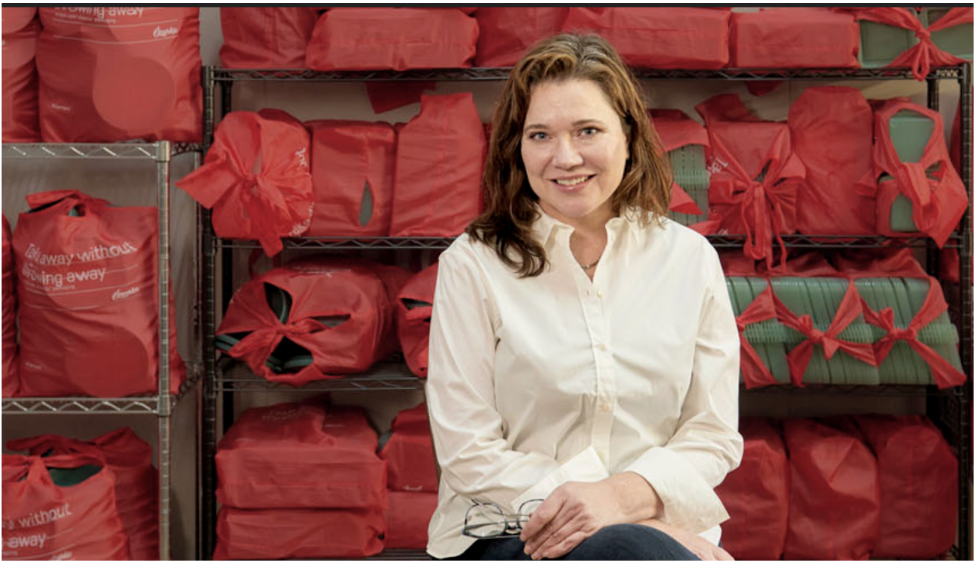
“Anyone who ever orders takeout food should always throw away those containers, bags and lids after eating. And many people have a bad feeling about that. I call it the ‘plastic hangover’. Our customers are mainly restaurants and caterers, who notice that their customers no longer accept all that single-use plastic. So they have to look for an alternative.” says Beth Massa
They propose a replacement of the (linear) takeaway disposable packaging system with (a circular) reusable containers solution, through Ozarka, a start-up launched in 2019, in the Netherlands. Their goal is to reuse containers in their original manufactured state, by means of three integrated solutions:
- Reusables as a Service (B2B)
- DeliverZero food takeout and delivery (B2C)
- ARK Reusables food packaging (B2B)
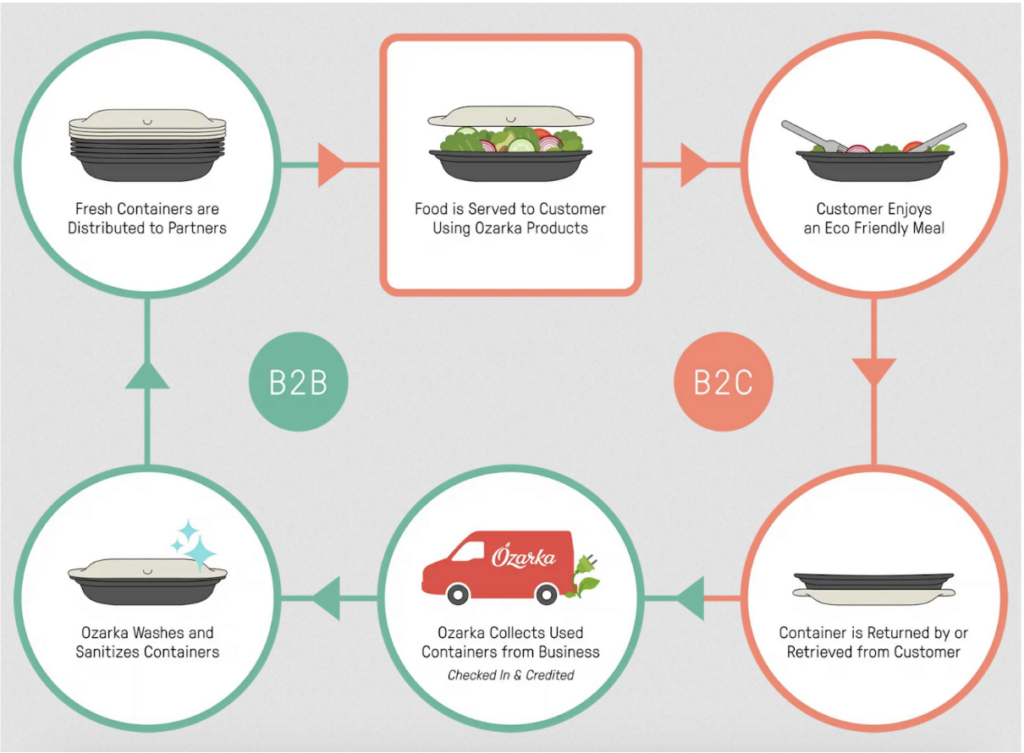
Ozarka’s Reusables as a Service (RaaS) is a simple B2B solution that gives restaurants, catering companies, festivals or event organisers a regular supply of clean reusable food containers. Their motto is “you do the food, we do the dishes”.
They provide the containers, pick them up after use from clients and customers, wash them, and return them in time for the next day’s service. They also plan to implement several systems for retrieving used containers, including smart dropboxes. Ozarka RaaS is charged per use, and its fees are in line with costs for high-quality disposables.
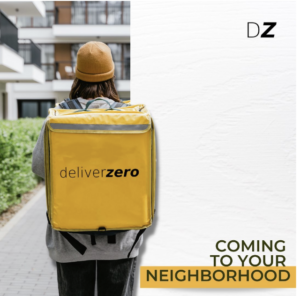
Ozarka partnered up with US-based Deliver Zero to offer food takeout and delivery service in returnable reusable containers. DeliverZero is a B2C solution, in which customers order via Deliver Zero online platform, and restaurants pack the food in reusable containers. The food can then be picked up from a restaurant or delivered home. Customers can return the reusable containers to any participating restaurant or through the delivery courier on the next.
DeliverZero order within 6 weeks. If they choose to keep a container, they will be charged a replacement fee, of €3,00 to €5,00 (depending on size and type of container), for each container that is not returned. After return, containers go right into regular dishwashing cycles of the restaurant.
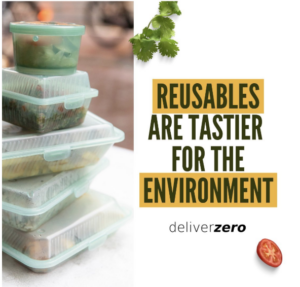
The Deliver Zero containers are made out of sturdy, highly durable polypropylene. They can be used to reheat food in the microwave at low temperatures, are dishwasher-safe, and can hold very hot liquids; and they are 100% BPA free. The containers typically last well over 1,000 uses, and at the end of life, they are recycled.
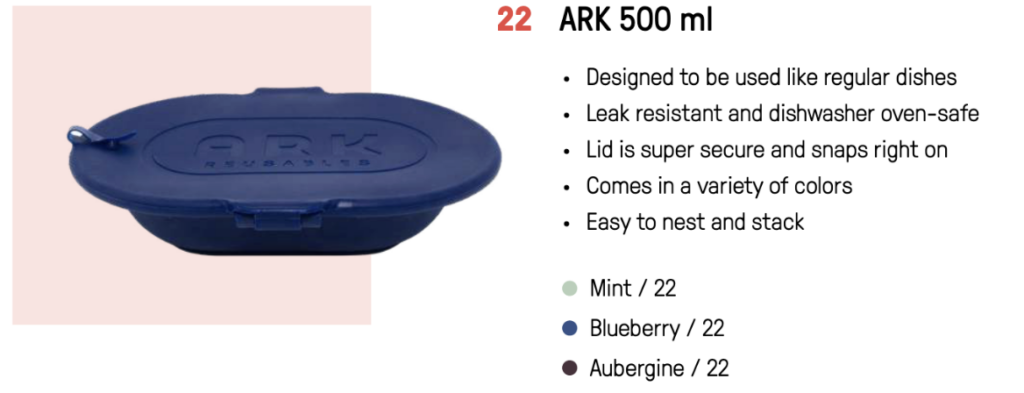
In addition to their services, Ozarka also offers a range of reusable food containers. The Ark line is ideal for company canteens, catering services, or any other food service that want to control the entire food transport cycle. They’re also a great solution for traditional takeout and delivery where Ozarka’s Reusables as a Service isn’t yet available.
Their food containers are made from food-grade silicone, borosilicate, and durable polypropylene. So they’re BPA-free and phthalate-free, stain and odour resistant. They’re all designed to stack and nest easily, taking up a minimum of space—just like disposables. The ARK Reusables containers can be reused up to 1000 times, thus reducing the environmental footprint of takeaway packaging. Ozarka takes full responsibility for recycling: when products are broken, damaged or maybe become too scratched, they reach end-of-life and Ozarka will take the products back and store them in order to have enough quantities for recycling.
“Competitors are focussed on the product as compared to a complete system or service offering.”– Michael Massa, co-founder of Ozarka
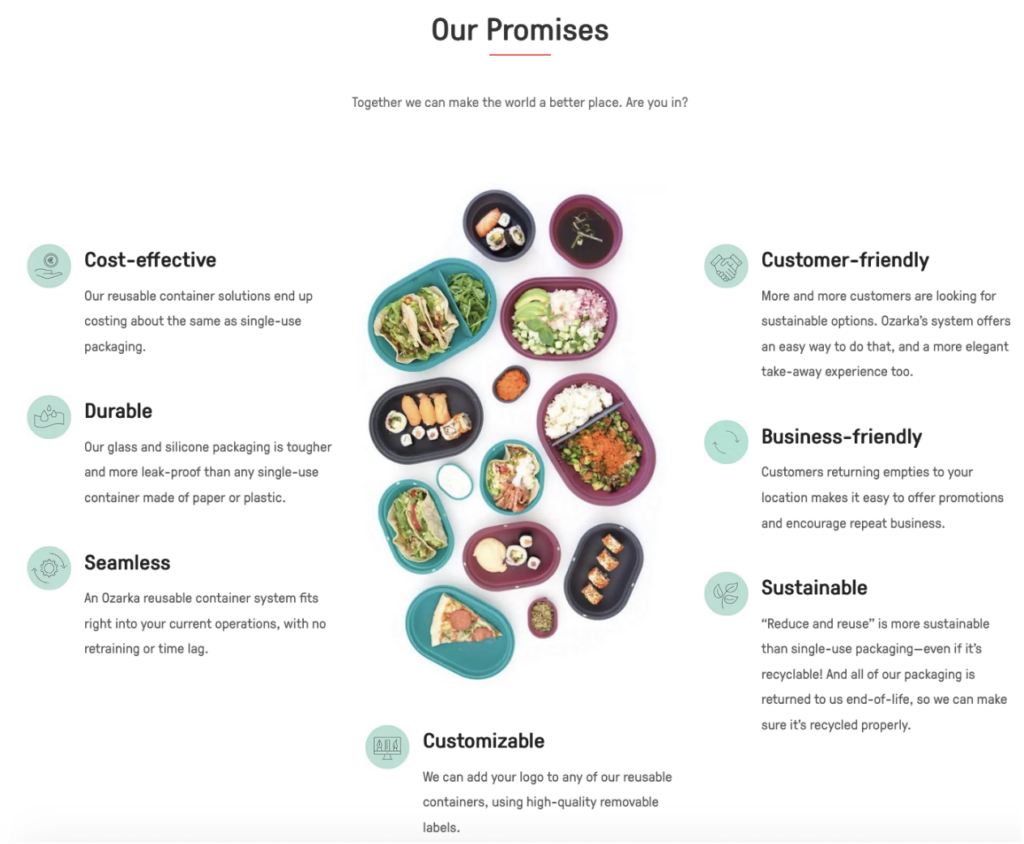
Their future plans include setting up a container deposit system, similar to the bottle return system, for which they are looking for collaborations with municipalities to implement public collection points. They also plan to replace the PP containers with a more sustainable alternative, that is yet to be found.
Ozarka is still in the start-up phase – investments are higher than revenues. They have 2 full-time employees and 15 flexible contractors. Container usages are rapidly increasing causing growth in turnover for each subsequent quarter and they expect to reach a point where there begin to be more revenues and fewer investments in the next 12-18 months.
Ozarka was valued at around 1 million euros in 2020. “I notice that the interest is increasing. Our first crowdfunding round of 240,000 euros was full within a day and the second round (500,000 euros) is also going well. For the next step, we are looking in our network more specifically for investors who dare to go outside the traditional path.” said Beth Massa in a recent interview.
Ozarka won the Karel de Vos Sustainability Award in 2022 and plans to become a major player in the reusable packaging industry, developing the concept from day one in such a way that they can market anywhere in the world. The company is also looking to expand abroad in the near future, in two markets outside of Europe that have not been named yet.
Impact Statement
Instead of a product offering, as is the case for their competitors, Ozarka implemented a service system, in which restaurants and catering businesses don’t have to implement the infrastructure for the collection, cleaning and redistribution of food containers. Through this packaging as a service solution for businesses and customers directly, Ozarka offers a seamless,
cost-effective and sustainable alternative to single-use food containers that enables a smoother adoption of circular economy practices by businesses.
According to Ozarka, reusable containers have a favourable argument possibly with as few as 3-5 uses, but certainly when containers are used dozens of times. They have been doing business since 2019 and some containers have been used once or twice a week since then.
Regarding environmental benefits, Deliver Zero, Ozarka’s partner, states: “The containers typically last well over 1,000 uses, which eliminates the emissions and waste from over 1,000 manufacturing processes. When one container chips or breaks it’s being retired and recycled. This is way better than conventional recycling. Recycling generates as much as 67% of the emissions of virgin-material manufacturing, because of the energy used in processing old materials and re-manufacturing. By contrast, DeliverZero eliminates all downstream production emissions. Reusing our containers also saves tremendous transportation energy. Single-use containers travel long distances from factory to restaurant to customer to dump. Our containers circulate locally among restaurants and diners, usually just within one neighbourhood. Though our containers are made abroad (in China and Taiwan), they are lightweight and travel here by cargo ship, a fuel-efficient journey more than made up for by the reductions in car and truck emissions.”
Even though Ozarka itself didn’t state the environmental impact of its own products, according to Upstream’s Reuse Wins report reusing containers a certain number of times (between 2-122 times, depending on the material) has a lower overall environmental impact than multiple SUP (single-use packaging).
Ozarka will always stay the owner of the product. Access to the containers is granted to their customers and includes the replacement of broken, damaged or missing containers. Agreements made with the food vendors cover an expectation of about 2% of containers to break or disappear. Ozarka takes financial responsibility for this amount unless items are obviously mishandled.
Another positive impact is made by taking responsibility for processing waste. With disposables, the consumers are left with an amount of garbage that they are responsible to dispose of. It then becomes the responsibility of municipalities to process the waste, but ideally, it should be a shared responsibility between manufacturers, distributors, users, etc. Hence, Ozarka takes containers back at end-of-life and takes responsibility for properly disposing of the container.
Systems Perspective
By providing a whole service rather than just a reusable product, Ozarka found a really clever solution to appeal to more customers than they probably would have by just selling reusable containers. Being themselves the owners of the containers and responsible for collecting, washing, sanitising and redistributing the food containers they fit easier into the standard operations of a business, making their service more adoptable.
Ozarka’s business idea can be applied in various retail and wholesale sectors – MiWa (for food supply chains), Packoorang and R-create (for e-commerce & parcel delivery) are such service providers, some of which were already covered in the 4Revs research previously. Usage of a circular service is an appealing option to existing businesses that don’t want to take care of logistics, cleaning, repair, redistribution and taking responsibility for packaging until the end of life themselves, but still want to (or in the future, they will need to) adhere to more sustainable business processes.
Food packaging as a service is a suitable option for urban areas in developed markets, where single portion ready meals are a goto option and the distances travelled by the containers between restaurant, customer and packaging service provider are short. By having set up an infrastructure with multiple, easy to reach drop-off points to return the containers, the service provider also ensures a high container return rate.
Ozarka is currently collecting the containers that reached the end of life but still has to find a suitable recycling partner. One of the materials used for their containers is PP – plastic, but Ozarka’s first goal is to use a material that allows dozens of reuses. They do not exclude using recycled materials in the future.
With reusables as a service customers pay a fixed price, between 25c and 45c per usage depending on size and material type. Ozarka’s current prices are not directly competitive with traditional disposables (e.g. made from polystyrene), their services are used by restaurants that are willing to have more responsible packaging and are already looking into other sustainable options (such as biodegradable or compostable materials).
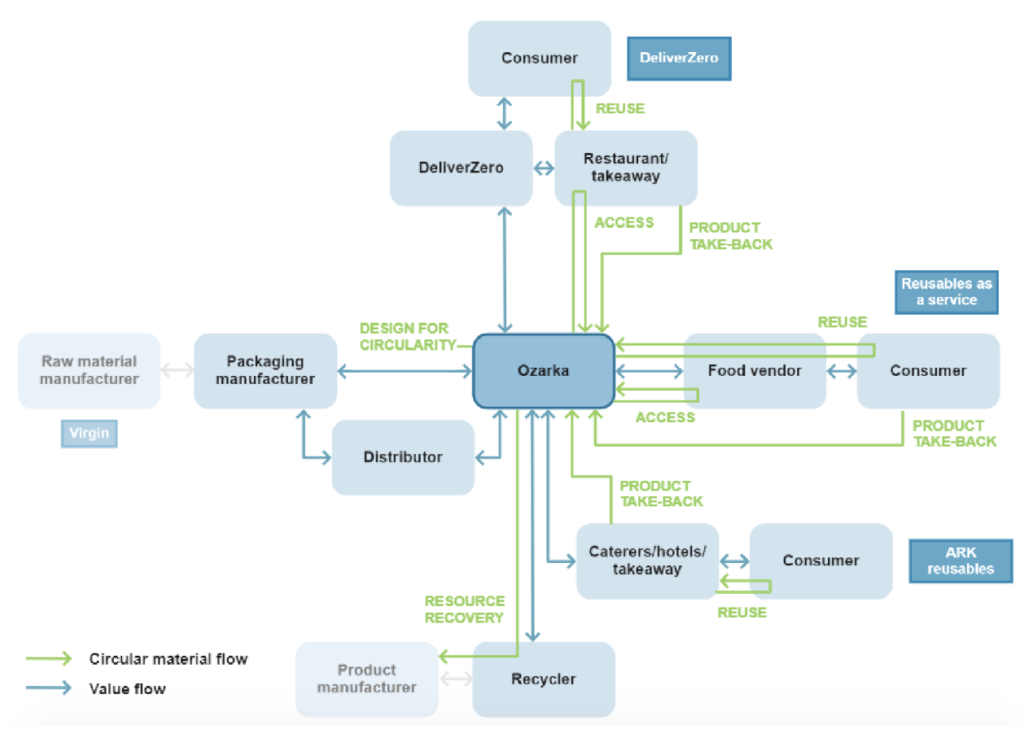
Within its business, Ozarka applies multiple circular strategies: reuse of containers in their original manufactured state, access to the product instead of owning it, product take-back at end-of-life, resource recovery by recycling broken or damaged containers and designing products for circularity. But Ozarka is still in its start-up phase – it remains to be seen if its second round of crowdfunding will be a success and if they manage to scale up to a sustainable number of clients.
Links and Contact Information
Links
Company website: https://ozarka.nl/?lang=en
Founders: https://www.linkedin.com/in/bethmassa
https://www.linkedin.com/in/michael-massa-1107b622/
Contacts: contact@ozarka.biz
Social media accounts
LinkedIn: https://www.linkedin.com/company/ozarka/
Instagram: https://www.instagram.com/deliverzeronl/
Twitter: https://twitter.com/OzarkaNL
Facebook: https://www.facebook.com/deliverzeronl/