
Main Theme
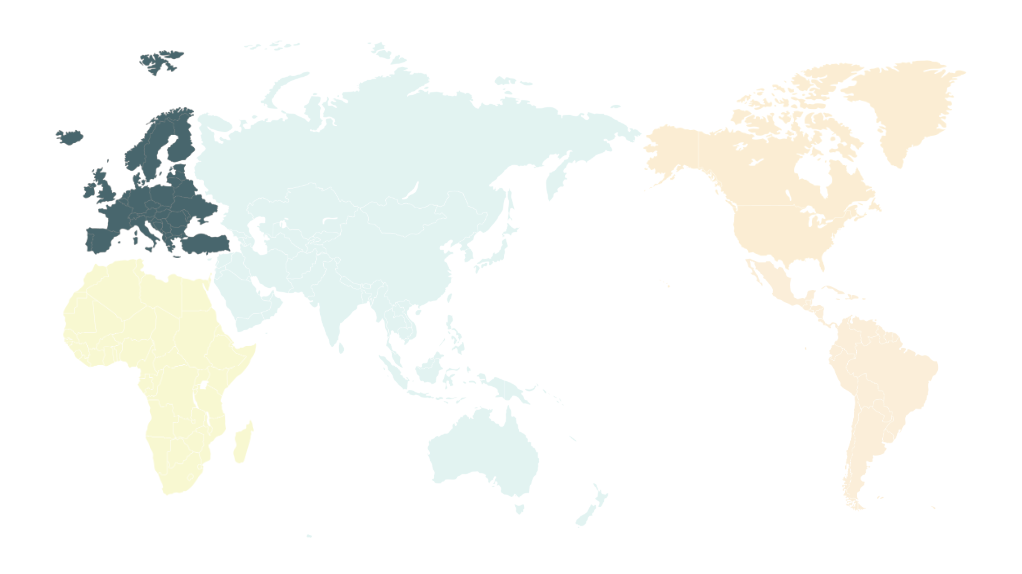
Sub-theme: renewable-energy, thermal-storage, energy storage solution, battery, heating solution
Abstract
More than 90% of heat power plants are CO2 emitters, they burn something (gas, oil, coal, peat, woodchips) in order to generate heat. Electricity and heat production are by far the largest contributors to global greenhouse gas emissions, accounting for 31% of all emissions in 2019. The current global energy crisis increases the urgency to reduce our dependence on fossil fuels. In order to massively reduce emissions, the heating sector needs to be electrified. But, with renewables being an increasing part of the energy mix, we need different solutions to store and retrieve energy depending on fluctuations in production and consumption.
A Finnish company, called Polar Night Energy (PNE), proposes an unusual battery to help solve the energy storage problem at a low cost and with a low impact on the environment. In 2021, in the town of Kankaanpää, western Finland, they installed the first high-temperature energy storage based on sand. It is connected to the town’s district heating network and its capacity is enough to provide heating and hot water for 100 homes and for a public swimming pool. The battery can store up to 8MWh of thermal energy and can discharge 200 kW of power through the heat-exchange pipes.
Conversion to thermal energy (stored as heat or refrigeration) is irreversible, for now, because of inefficiency, but since heating and air conditioning represent a major component of peak demand loads, this technology can have a major impact by storing energy when production is high or when demand is lower, and using it when needed.
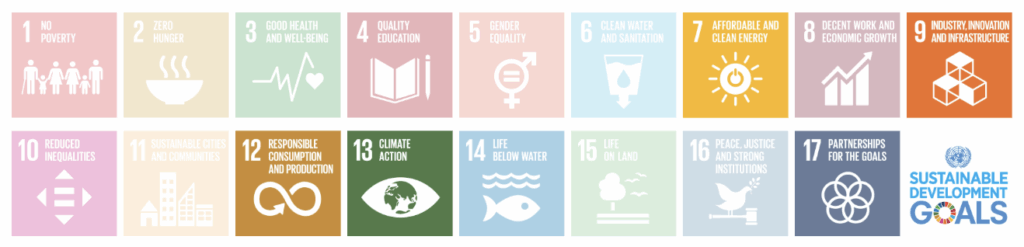
Sustainable Development Goals Chart
Main Highlights
Problem: Electricity and heat production are by far the largest contributors to global greenhouse gas emissions, accounting for 31% of all emissions in 2019. The heating sector relies heavily on dirty fossil fuels and needs to be electrified in order to reduce emissions massively.
Context: With renewables being an increasing part of the energy mix, we need different solutions to store and retrieve energy. The solutions need to account for fluctuations in production and consumption, and optimise the chain of energy production and consumption.
Thermal energy storage has an efficiency of almost 100% (if not converted back to electricity) and can be used to make both heating and air conditioning systems operate in better harmony with the electrical power supply.
Solution: The Polar Night Energy (PNE) team proposes the usage of high-temperature energy storage systems based on sand and sand-like materials for solving the renewable energy storage problem. The battery stores energy as heat in the sand at a low cost and with a low impact on the environment.
Impact Statement: The battery can store up to 8MWh of thermal energy and can discharge 200 kW of power through the heat-exchange pipes. Its capacity is enough to provide heating and hot water for 100 homes and for a public swimming pool.
Systems Perspective: More than 90% of heat power plants are CO2 emitters, they burn something (gas, oil, coal, peat, woodchips) in order to generate heat. PNE offers an emission-free alternative to these current heating systems and, if scaled up, the sand battery can have a variety of other possible usages such as the generation of electricity and capturing of heat waste from industrial processes.
Case Overview
Electricity and heat production are by far the largest contributors to global greenhouse gas emissions, accounting for 15.83 billion tons of CO2eq (31% of all emissions in 2019). The heating sector relies heavily on dirty fossil fuels and needs to be electrified in order to reduce emissions massively. In addition, Russia provided the EU with 39% of its natural gas and 25% of its oil in 2021. This reliance on Russia had long been identified as a strategic weakness. The global energy crisis triggered by Russia’s invasion of Ukraine increases the urgency to reduce our dependence on fossil fuels and funding authoritarian regimes.
Thanks to a combination of scale, technological improvements and carbon-pricing mechanisms the cost of renewable energy generation decreases. With renewables being an increasing part of the energy mix, we need different solutions to store and retrieve energy depending on fluctuations in production and consumption. There are numerous types of energy storage technologies available, such as mechanical (e.g. pumped hydro storage), electrochemical (e.g. lithium-ion batteries) or thermal (e.g. molten salt). Thermal energy storage has an efficiency of almost 100% (if not converted back to electricity) and can be used to make both heating and air conditioning systems operate in better harmony with the electrical power supply. Conversion to thermal energy (stored as heat or refrigeration) is irreversible, for now, because of inefficiency, but since heating and air conditioning represent a major component of peak demand loads, this technology can have a major impact by storing energy when production is high/demand is lower and realising it when needed.
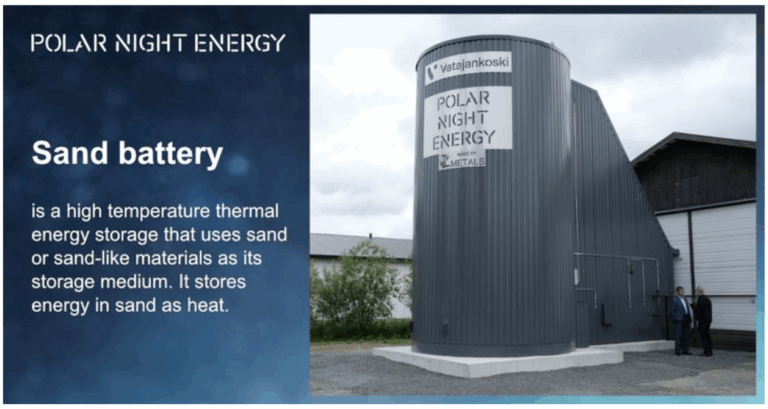
In July 2022, in the town of Kankaanpää, western Finland, a team of young engineers installed the first commercial-scale sand battery in the world. The Polar Night Energy (PNE) team believes the unusual battery can help solve the energy storage problem at a low cost and with a low impact on the environment. The battery stores energy as heat in the sand. Their first commercial battery is connected to Kankaanpää’s district heating network which is operated by an energy utility company called Vatajankoski.
Tommi Eronen, Polar Night Energy’s CEO, came up with the idea in 2016 while doing research for his engineering Master’s degree. He was looking into water-based storage systems for renewable energy, but while reading an article about traditional Finnish fireplaces, made from stone and sand, Eronen had a lightbulb moment: “would a solid material, rather than water, be more suitable for storing solar and wind energy?”.
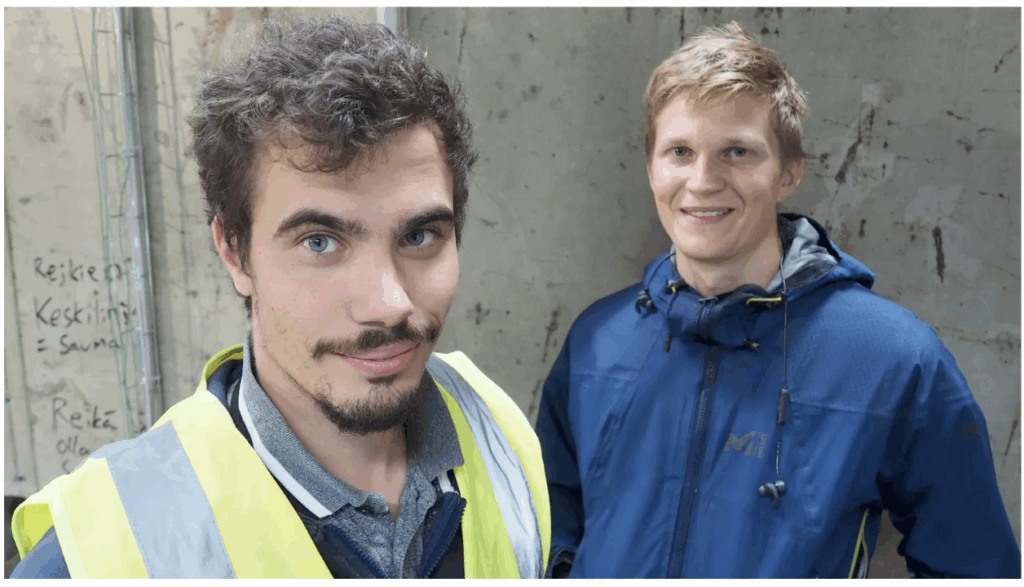
Markku Ylönen and Tommi Eronen, the co-founders of Polar Night Energy
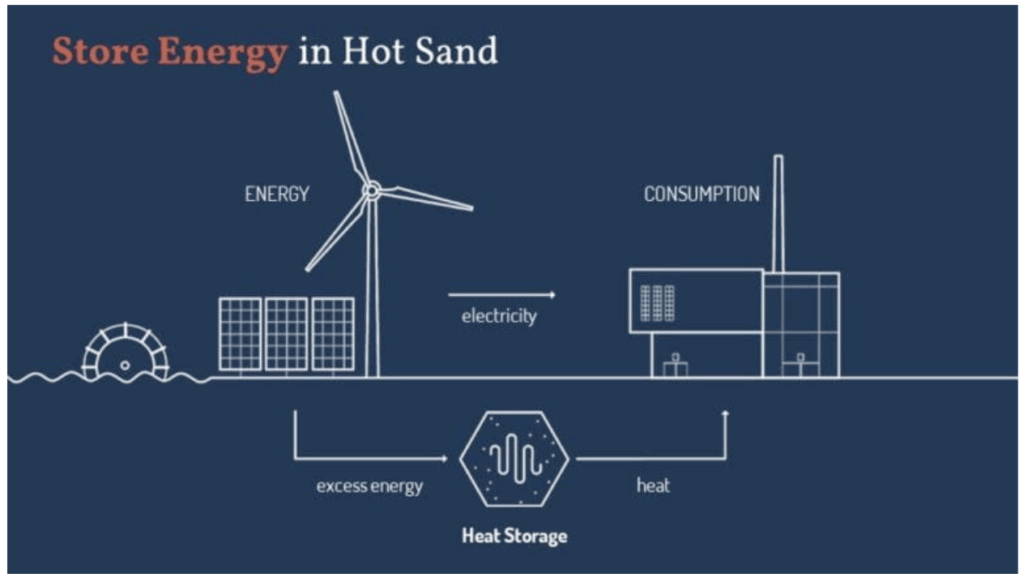
The battery consists of 100 tonnes of low-grade builder’s sand, two district heating pipes and a fan. How does it work? Renewable energy (wind & solar) powers a resistance heater which heats up the air inside the 7m high steel container filled with sand. Through heat exchange pipes, hot air is circulated by a fan around the sand, heating it up to 600°C. The container is surrounded by thick insulation that helps keep the sand at high temperatures for hours to months.
The battery can store up to 8MWh of thermal energy and can discharge 200 kW of power through the heat-exchange pipes. Its capacity is enough to provide heating and hot water for 100 homes and for a public swimming pool in Kankaanpää.
Polar Night Energy heat storage can be connected to most heat transfer systems and is compatible with heat pumps. The system can produce hot water for water-circulating systems, as well as hot air and process steam for industrial use.
Growth/expansion plans
Polar Night Energy is currently in the process of signing a contract to build a second battery for another district heating company in Finland. This battery will be 10 times bigger than the one in Kankaanpää, with 2MW heating power and 500MWh storage capacity.
They are also looking at possible opportunities in the industrial sector, where various processes require high heat, such as steelwork, laundry, bakeries etc. A sand battery can give such companies flexibility to charge the battery when electricity prices are lower (e.g. during the night or when reusable energy generation is peaking).
Impact Statement
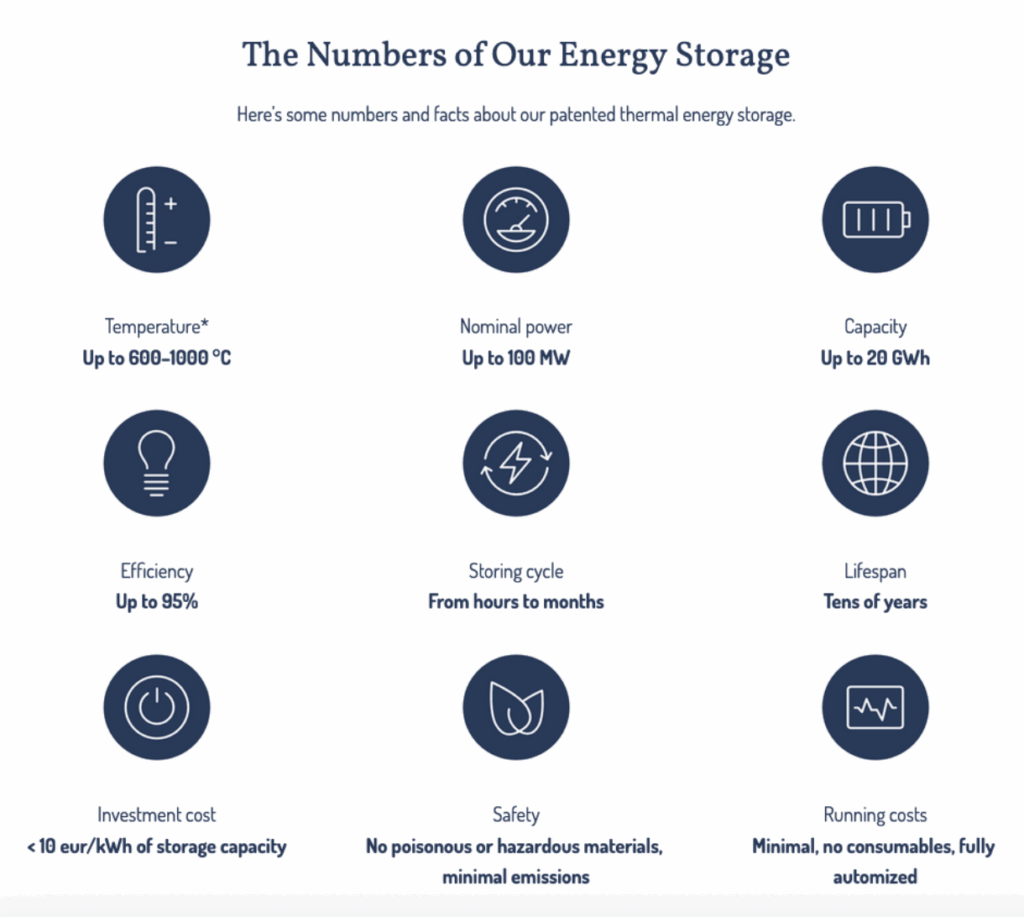
The efficiency of PNEs thermal storage is 80–90 %, depending on its size. The loss is mainly caused by possible heat leaks. The bigger the scale of the container, the better the efficiency of the storage becomes and less insulation is needed because heat escapes at the surface of the container. Between 0,5m and 1m of insulation material is needed around the sand storage.
The overall efficiency also depends on how long the heat is stored. Nordic countries, such as Finland, need viable, long-term storage of renewable energy because of the long hours of darkness and an increased need for heat in the winter, but extended hours of sunlight in the summer. PNE plans to do exactly that: charge the battery during the summer months, when solar energy generation peaks and release it as heat in the long winter months, when demand is at its highest.
According to their website, the CO2 emissions of their heat storage are mostly emissions from construction materials and from the construction phase. As these embedded emissions of the Polar Night Energy (PNE) heat storage are minor, the emissions of produced heat result mostly from the source of electricity.
“It can be said that the heat taken from our storage is
as clean as the electricity fed into the storage was.”
According to an assessment conducted by Mission Innovation in 2020, Polar Night Energy’s Sand-Based High-Temperature Seasonal Heat Storage innovation may have:
- A strong positive impact on SDG nr 7: Affordable and clean energy
Motivation: In alignment with SDG target 7.2: “By 2030, increase substantially the share of
renewable energy in the global energy mix”. The innovation enables upscaling of wind and
solar energy. In that way, clean energy is available during periods when today is not
available.
- A partial positive impact on SDG nr 9: Industry, Innovation, and Infrastructure
Motivation: In alignment with SDG target 9.2 “Promote inclusive and sustainable
industrialization and, by 2030, significantly raise industry’s share of employment and gross
domestic product, in line with national circumstances, and double its share in the least developed countries”. The innovation enables access to cheap and clean energy during all hours.
The international initiative Mission Innovation has estimated that Sand-Based High-Temperature Seasonal Heat Storage enables the potential avoidance of 169.8 MtCO₂e/year in 2030.
The sand battery is almost maintenance-free: certain parts, such as the fan and heat exchanger, wear out over time, but they are easily replaceable. Their piping systems have a simple design and can be made by standard metal workshops, so they don’t need custom factories. This makes their design easily implementable and scalable in different regions across the globe. In addition, their design doesn’t depend on a certain type of sand. In fact they are looking for locally sourced cheap sand that is not needed elsewhere (e.g. construction sector). PNE is also looking at replacing sand with other granular, non-flammable materials for regions across the globe where there’s a shortage of sand.
The life cycle of such a battery is tens of years as the sand does not wear out or corrode substantially despite the temperature fluctuations (no chemical reactions take place). The service life of the sand battery depends more on the progress in technology, as the equipment may eventually become obsolete.
More than 90% of heat power plants are CO2 emitters, they burn something (gas, oil, coal, peat, woodchips) in order to generate heat. PNE offers an emission-free alternative to these current heating systems. Its solution has multiple applications:
- Seasonal heat storage – storing heat from weeks to months
- Peak power heating plant – heat storage as a reserve or peak power heating plant (alternatively fossil fuel plants are commonly used today to ensure peak demand)
- Carbon neutral district heating (by using wind and solar to charge the sand battery)
- Process heat production for industries – generation of high-temperature process steam or usage of stored heat directly in a high-temperature industrial process. Additionally, costs can be reduced by acquiring electricity for heat generation at the lowest prices of the hourly energy market
- Recovery of waste heat from industrial processes (the sand battery offers temporal flexibility in heat storage)
- Solar and wind energy storage
Systems Perspective
The International Energy Agency’s (IEA) annual World Energy Outlook (WEO) is published every autumn. This year’s (2022) outlook raises concerns over rising geopolitical tensions and millions of people losing access to energy due to fossil fuel price inflation. It says that “with energy markets remaining extremely vulnerable, today’s energy shock is a reminder of the fragility and unsustainability of our current energy system”. For the first time, a WEO scenario based on current policy settings reports that fossil fuel use will peak within five years.
Our reliance on intermittent renewable energy production will heavily grow while decarbonising the energy system. In order to secure our future energy system and match the imbalance between the time of production and the time of usage of renewable energies, we need to deploy different energy storage solutions. Replacing petrol and diesel with electricity requires batteries. Phasing out natural gas and replacing it with solar thermal or geothermal requires large-scale thermal storage. Conversely, developing possibilities to store intermittent solar & wind energy could facilitate the growth of the renewable energy sector. Other similar cases on the 4 revs platform that focuses on innovations in energy storage technologies are Nant de Drance – pumped hydro storage, Sila’s Lithium Battery, AquaBattery and a Meso case focusing on battery materials & tech innovations in Asia.
Using sand, a solid material, as energy storage has some advantages over other materials: If compared with water – it can be heated to temperatures well above the boiling point (100°C). Sand-based heat storage can store several times the amount of energy that can be stored in a water tank of a similar size; this is thanks to the large temperature range allowed by the sand (600-1.000°C). It saves space and allows versatile use in many industrial applications.
Lithium-ion batteries continually degrade, even when not in use. In comparison, no chemical reactions occur in sand batteries, keeping the material in the same condition for decades. Lithium-ion batteries are also not suitable for large-scale usage and have a much bigger environmental impact. The quality and granularity of sand are not important, therefore materials that aren’t suitable for construction or other usages can be valorized, keeping the cost low and not putting pressure on scarce resources. Polar Night Energy’s sand battery has an 8 to 10 times lower cost per unit of energy stored compared to a lithium-ion battery. But, when it comes to space a sand battery stores 5 to 10 times less energy (per unit volume) than traditional chemical batteries. With currently available technology the process of converting heat back into electricity only has an efficiency rate of 30%, another big disadvantage of the sand battery.
The thermal energy storage proposed by the Finnish company has a variety of possible usages if scaled up:
- generation of both electricity and heat,
- Suitable for industrial use and in district heating systems,
- capturing of heat waste from industrial processes
At its current scale, the innovation is suited mostly for urban areas, with district heating infrastructure, in cold regions, with long winters, where heating is needed for a large part of the year. Even without improvement in efficiency for returning the power to the electrical grid, PNEs thermal storage has a large market share by storing and distributing energy as heat to a multitude of settings (residential, commercial or industrial).
Links and Contact Information
Projects website: https://polarnightenergy.fi
E-mail: contact@pne.fi
Tommi Eronen, CEO: tommi.eronen@pne.fi
Markku Ylönen, CTO: markku.ylonen@pne.fi
Matti Ulvinen, Product Sales Manager: matti.ulvinen@pne.fi, +358 40 838 5767.
Social media accounts
LinkedIn: https://www.linkedin.com/company/polar-night-energy-oy/
Twitter: https://twitter.com/pne_energy
Case by: 4Revs Researcher Anamaria Georgescu | December 2022