Main Theme
Sub-theme: Water; water access; water management; community management; Puquios; ancient wells; ancient technology; glocal systems of climate resilience.
Abstract
Water is an essential element for life on earth. And although 71% of the earth’s surface is covered by water, only 0.3% of it can be used by humans. In Latin America and the Caribbean (GOMEZ, 2021), about 24 million people do not have access to safe drinking water sources. In addition, the climate crisis is threatening water access and sanitation all around the globe. There’s a global water crisis from Cape Town to Flint, Michigan, and from rural, sub-Saharan Africa to Asia’s teeming megacities. People are struggling to access the quantity and quality of water they need for drinking, cooking, bathing, handwashing, and growing their food.
Fantastic progress has been made in making clean water more accessible, with people lacking access to clean water decreasing from 1.1 billion in 2000 to 785 million in 2017. But there are still many opportunities. This case study will investigate the ancient Puquio wells of Nasca: a particular form of wells located on the southern coast of Perú, one of the world’s driest areas. The Puquios draw water from the subsoil, bringing water to the surface. This water system was built back in 600 A.D, and it’s still used for agricultural purposes.
We live in a world where states and corporations provide water and sanitation based on a privatized and individualistic model. What can we learn from looking at a more local and communitarian approach toward water access? What can we learn from this ancient engineering system?
Sustainable Development Goals Chart

Main Highlights
Problem
- About 34 million people in Latin America and the Caribbean (18% of the region) do not have access to safe drinking water sources.
- Due to population growth, urbanization, and climate change, competition for water resources is expected to increase, impacting agriculture. The population is expected to increase to over 10 billion by 2050, and whether urban or rural, this population will need food and fiber to meet its basic needs.
Context
- Perú’s southern coast is one of the world’s driest areas.
- The climate crisis is threatening water access and sanitation all around the globe. Puquios are engineering systems that help provide climate resilience to communities.
Solution
- The ancient Nazca civilization created a method of extracting water from the subsoil through an impressive network of Puquios found in four valleys of the Nazca province.
- This network of puquios, similar to the “filtering galleries” of Spain or the “Qanats” of the Middle East, still exists today and, in some part, are still in operation.
Impact Statement
- Built back in 600 A.D, the quality of the Puquios construction is so impressive that some of the Puquios still function today.
- In the past, the management of Puquios was crucial for the community. In their societal hierarchy, one of the highest members were the “Puquio managers,” since they managed control of water distribution.
Systems perspective
The discovery of this type of hydraulic engineering is recent. There are few studies of Puquios and the possible application of this ancient technology in cities and other latitudes. However, this case study aims to analyze a different approach towards water access and sanitation: glocal systems of climate resilience.
Case Overview
Recently, the purpose of these spirals (see image 1) was revealed. A team of researchers at the Institute of Methodologies for Environmental Analysis found evidence suggesting that these structures are part of an intricate and sophisticated ancient water distribution system.

Image: An entrance to the “Puquios,” near Nazca, Perú. Image: Phys.org
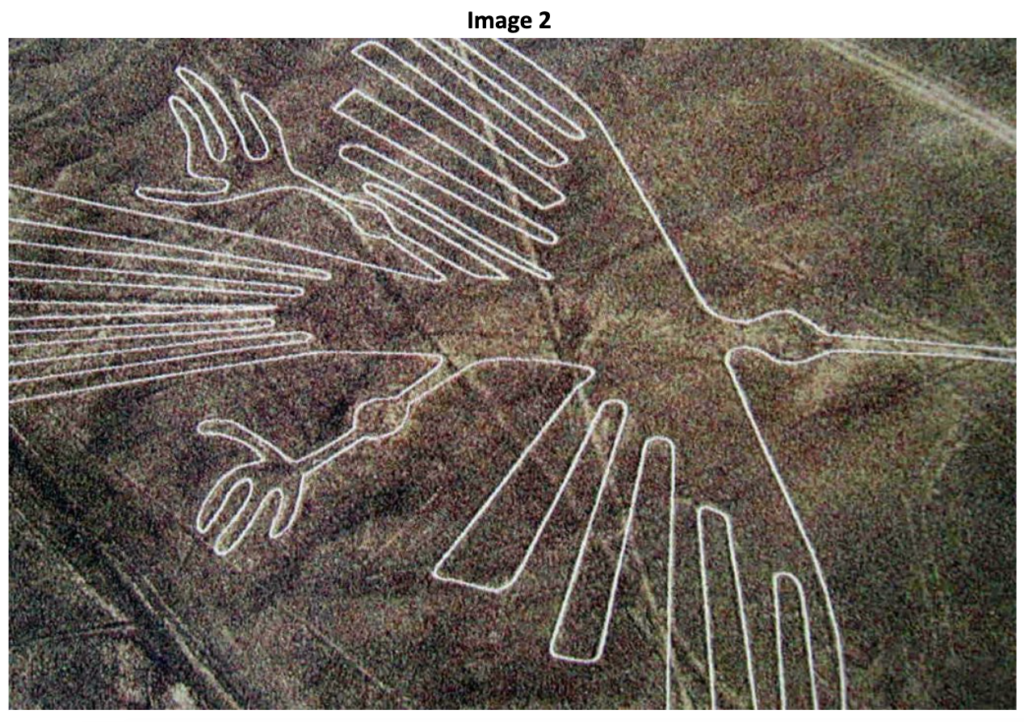
They are located near the “Nazca Lines” (see image 2), and they are also the work of the Nazca people, that lived in the area from sometime before 1000 B.C. to approximately 750 A.D.
The name puquio is a Quechua word meaning “natural spring.” The southern coast of Perú is one of the world’s driest areas, which is why these natural springs, or “aqueducts,” were a key engineering system, allowing agricultural activities all year long in a desertic zone.
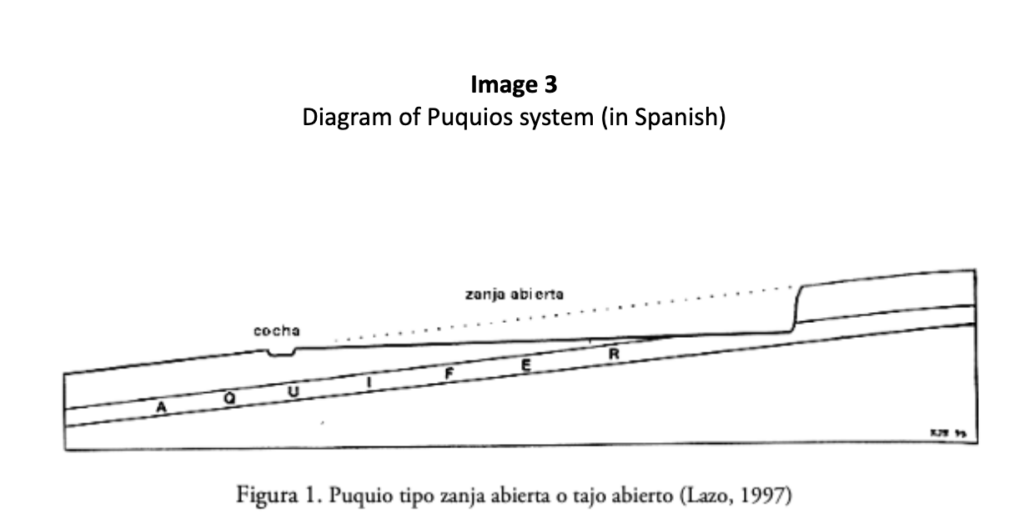
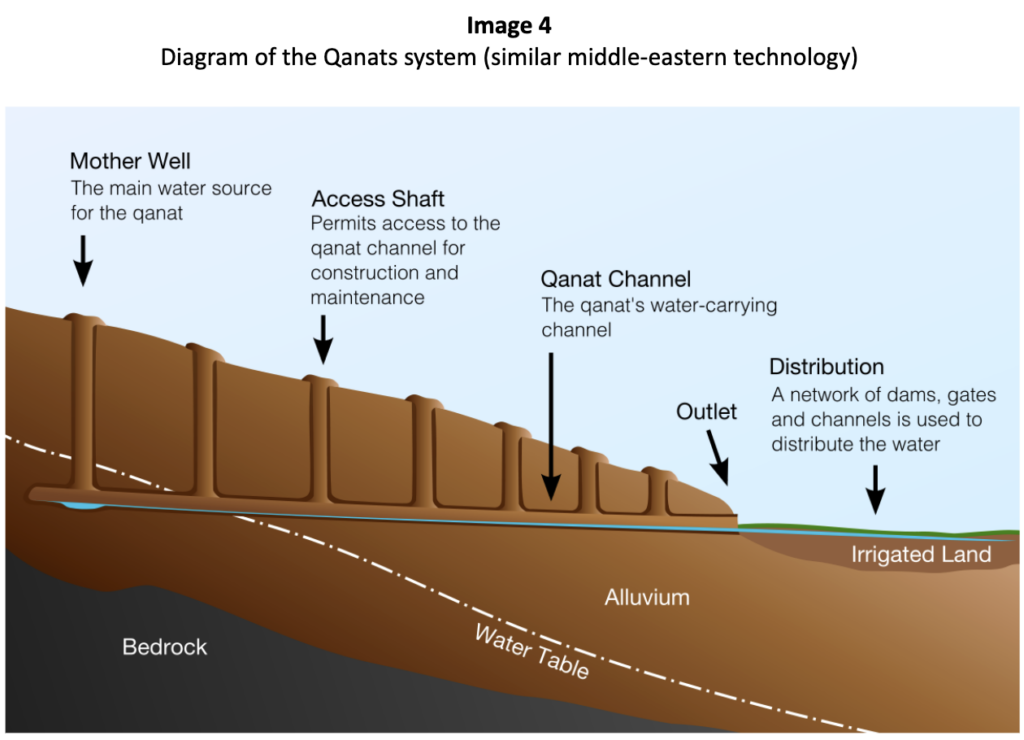
- How do they work? (see images 3 and 4)
A series of canals transport the water, trapped underground, to the areas where it is needed (irrigated land). Any remaining water was stored in reservoirs on the surface. Chimneys were dug over the canals in the form of spiral funnels (image 1) to aid transport. These funnels allowed the wind to enter the canals, forcing water to flow through the system.
- Glocal systems of climate resilience.
To ensure democratic access to water, almost every drinkable water source on this planet is, in one way or another, managed. Nevertheless, a water well in the desert meant even a bigger deal.
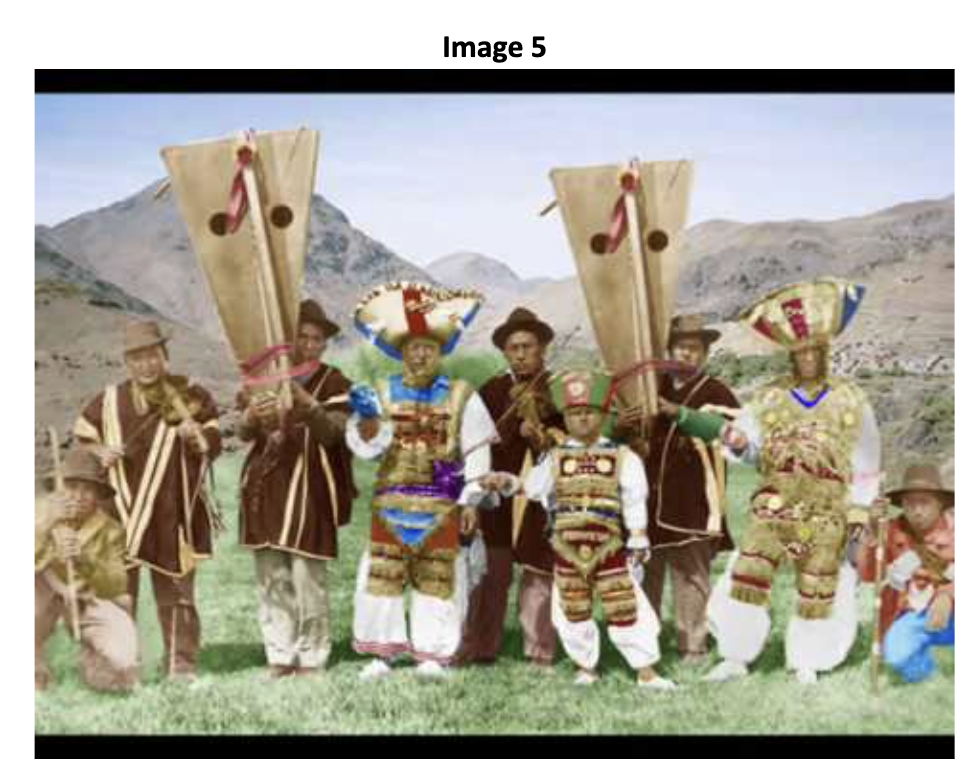
Recreation of the Nazca civilization dancing for the Puquios as part of an ancient ritual to show appreciation and respect for water. The image is taken from Alba.
The water crisis is a glocal challenge: it affects people all around the globe, but it needs to be addressed locally. In a world where states and corporations mainly bring water access and sanitation in a privatized and individualistic approach (companies and states ensure water access for individual households), it seems relevant to look at Puquios as a way to provide water access for communities.
The ancient Puquio managers had a powerful influence on the community. According to Rosa Lasaponara from the Institute of Methodologies for Environmental Analysis, “It is likely that the maintenance [of the Puquios] was a socially organized collaborative system, similar to that adopted for the construction of the famous Nazca lines, which in some cases are clearly related to the presence of water.”
Lasaponaara also ensures that the puquios were vital for “those who had power over the communities to control the distribution of water and assert their influence,” since the knowledge of how to bring water to one of the driest places on Earth meant that they held the real key to life in their hands.
Puquios were maintained and managed by collaborative efforts amongst the community. Both Puquios and Qanats are glocal and coordinated systems of climate resilience. These structures cannot survive without proper maintenance and management. While maintenance is needed for its functioning, management is necessary to ensure democratic access to water for every member or every field of the community. A great effort, organization, and cooperation are required for its construction and regular maintenance.
In conclusion, these forms of climate resilience also need a strong focus on community building. The surprising societal organization of the Nazca civilization was the reason for the Puquios to be functioning until today. Today, the same level of appropriation and respect for this resource (water) will be needed to ensure alternative types of water access systems.
Impact Statement
In the past, the management of Puquios was crucial for the community. One of the highest members in their societal hierarchy were the “Puquio managers,” since they managed control of water distribution: the most vital element on Planet Earth.
According to Lasaponara, the Puquios were the most ambitious hydraulic project in the Nazca region. They provided water throughout the year, not only for agriculture and irrigation but also for domestic needs. This author wrote a book on her satellite studies entitled “Ancient World Nasca: New Insights from Science and Archaeology.”
Not so long ago, other types of wells or holes in Kenya became viral on social media. They are called “Bunds,” They work as a container for rainwater, allowing vegetation to grow in and around the holes.
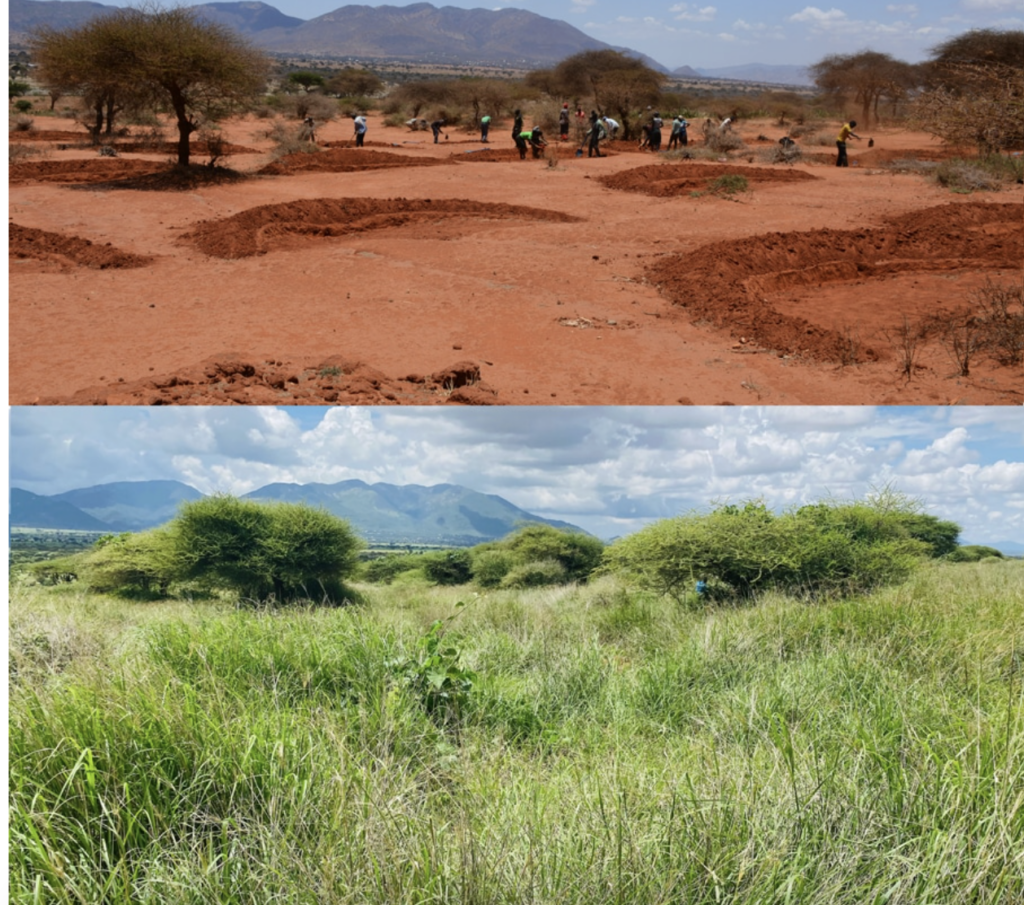
Image: Bunds in Kenya. Before and after. The image is taken from Atlas of the Future.
Bunds are especially important in the fight against climate change and erosion. Also, working as a climate resilience methodology, bunds and puquios show that the community has a significant role in regenerating ecosystems. Both bunds and Puquios are/were managed by the community, and they both seek to discover new ways of obtaining water.
Systems Perspective
In a world where states and corporations mainly provide water access and sanitation through a privatized and individualistic approach (companies and states ensure water access for individual households), it seems interesting to look at Puquios as a way to provide water access for communities.
According to the World Water Council, the percentage of people in Latin America and the Caribbean with direct access to water has increased from 33% of the population in 1960 to 85% by 2000. Nevertheless, this leaves 77 million people without a water connection in their homes -51 million rural residents and 26 million urban ones.-
In a world where a climate crisis is challenging the future of humanity, these Puquio wells can serve as an example of glocal and communitary systems of climate resilience. Leaving aside the complexity of the engineering behind the Puquios, these ancient structures were built in one of the world’s driest areas, transforming it into an immense agricultural valley, thanks to the effort of an entire community.
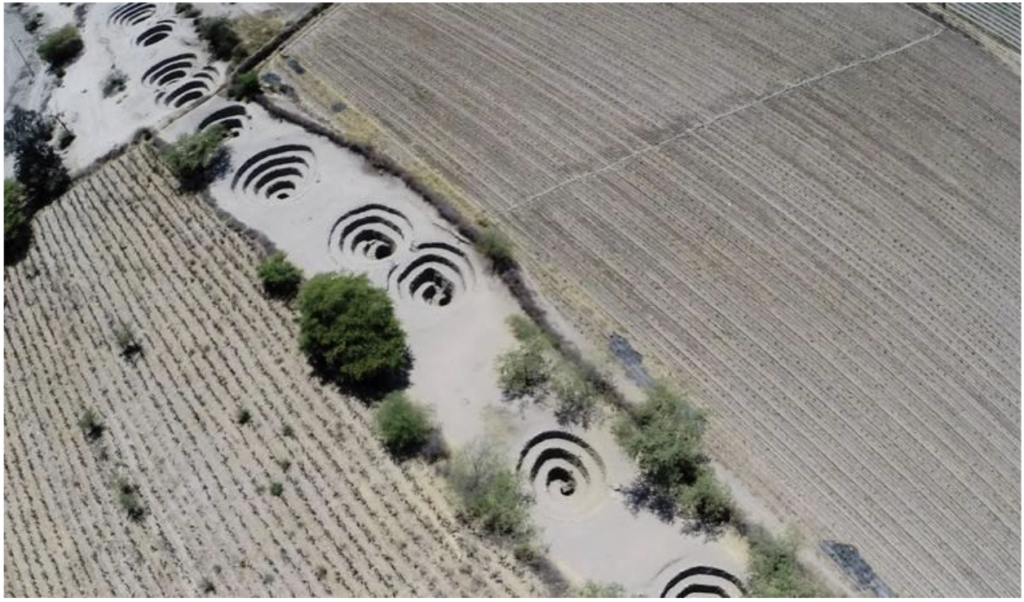
Agricultural lands were settled in proximity to Puquios. Picture: Treehugger
Puquios may not be applicable to all urban areas (they rely on water from the surrounding mountains).
Nevertheless, they may be appropriate in rural areas across Latin America.
Puquios are a local solution to a global problem: water scarcity. And the system in which they work ensures a strong community that needs to act in coordination to keep the water running throughout the entire year.
4Revs Researcher Christopher Brosse | May 2022